
- Home
- Arthur C. Clarke
Glide Path Page 23
Glide Path Read online
Page 23
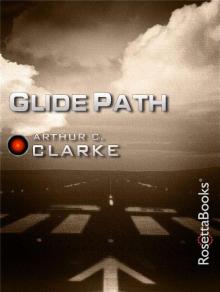
For the very last time, Right Lieutenant Bishop swung open the door of the control van and stepped inside, lighting the way with his bicycle lamp. Dim and lifeless now, the elevation and azimuth displays stared blankly at him. Never again would luminous glowworms crawl across the indicator tubes as aircraft were tracked down the sky; never again would the WAAF operators crank their handwheels as they followed the echoes toward the runway. Half the electronic circuits had already been stripped and the panels removed; loose wires and coaxial cables hung everywhere, like the tendrils of dying vines.
A quarter of a million dollars’ worth of gear was disintegrating, and no one cared; its work was done. There had never been any proper stock-taking on the Mark I, and now its components were vanishing at a quite amazing speed. The more valuable and useful parts, and all the secret tubes, had gone back to Stores; for the rest—well, most of the mechs seemed to be building their private radios, and Mac was assembling a personal cathode-ray oscilloscope. The Mark I was a derelict ship that had been overrun by wreckers.
This dim and dusty truck was full of ghosts. Alan slid into the controller’s seat, and swiveled around to look at the meter panel. Upon these needles, now all resting on the zeros from which they would never stir again, his life had once depended. The monologues of a thousand talk-downs mingled and reverberated along the corridors of memory. Ranger calling C Charlie… Fife miles to go… Reduce rate of descent… Three degrees left… Check undercarriage down… Go ahead and overshoot… Change to Channel B… Are you receiving me?… Over and out… Over and out…
He stared at the lifeless meters, no longer seeing them. The first time he had stepped into this van, he had been a callow Flying Officer not long out of radar school. Now, so much had happened to him, for good or bad, that he could scarcely remember how he had felt in those distant days, not yet a year ago.
Lovingly, he stroked the worn plastic of the bench. He was saying good-by to an old friend, whose triumphs and disasters he had shared through the most critical, and most formative, period of his life. Whatever the future brought, he knew that he could never feel the same about the factory-built Mark II.
He had not cried at his father’s grave, but now the tears were trickling down his cheeks. How strange—indeed, how perverse—to weep for a machine! Even one with as complex and temperamental a personality as the Mark I did not merit the tribute of tears; why, then, was he weeping now?
There was no simple answer; his sadness came from a multitude of causes, and alcohol was the least of them. The sorrow he felt was that which every man must know when a chapter of his life closes and he leaves forever a spot where he has experienced much, of either good or evil.
Some of those tears were for his father—or what his father might have been, had fate ruled otherwise. And some were for Lucille; she had given him happiness, and only fools spurned that—but she had not given him love. Alan suspected, a little uncomfortably, that her memory would warp and color his emotions for years to come. That was a problem he must meet when it arose. No one could foresee the future, or guard himself against all its contingencies.
Alan rose from the swiveling seat, took a last look around the control van, and quietly left. As he closed the door behind him, it seemed to snap the threads of many friendships. Good-bye, he thought, to Howard and Pat and Benny; good-bye to Doc Wendt and Professor Schuster, wherever they might be. He wondered if he would meet them again, in the unimaginable world beyond the war.
It was quite possible, for he had become entangled in powers and instrumentalities that would surely shape the future. But first the war itself had to be won. In the momentous months ahead, the men he was training would be setting up their equipment on bomb-scarred airfields in liberated Europe, and beside runways of crushed coral on far Pacific islands. And perhaps he might be with them, facing unknown perils and hazards.
There was no GCD to guide him past these, no FIDO to clear away the mists that veiled the future. Nor did he need such aids; and in recognizing that fact, he had come at last to the beginnings of wisdom and maturity.
 Time's Eye
 The Sentinel
 Prelude to Space
 Earthlight (Arthur C. Clarke Collection)
 2001: A Space Odyssey
 Against the Fall of Night
 Glide Path
 The Lost Worlds of 2001
 The Trigger
 Reach for Tomorrow
 Islands in the Sky
 The Songs of Distant Earth
 2010: Odyssey Two
 Childhood's End
 3001: The Final Odyssey
 The Fountains of Paradise
 Rama: The Omnibus
 The Hammer of God
 Beyond the Fall of Night
 Tales From Planet Earth
 2061: Odyssey Three
 Tales From the White Hart
 The City and the Stars/The Sands of Mars
 The Star
 Imperial Earth
 The Light of Other Days
 Firstborn
 The Other Side of the Sky
 Cradle
 The Wind From the Sun
 The Ghost From the Grand Banks and the Deep Range
 The Deep Range
 Expedition to Earth
 A Fall of Moondust
 Dolphin Island (Arthur C. Clarke Collection)
 Richter 10
 The City and the Stars
 Tales of Ten Worlds
 Dolphin Island
 Expedition to Earth (Arthur C. Clarke Collection: Short Stories)
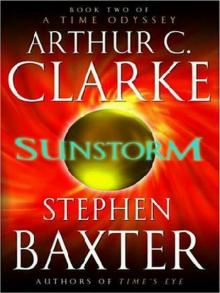 Sunstorm
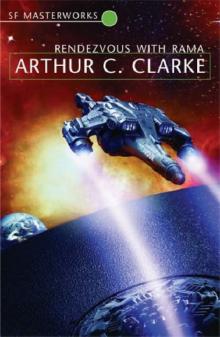 Rendezvous with Rama
 The Collected Stories of Arthur C. Clarke
 Trouble with the Natives
 Rama Revealed r-4
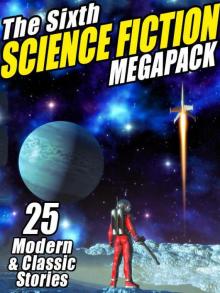 The Sixth Science Fiction Megapack
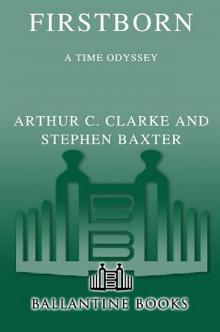 Firstborn to-3
 The Ghost from the Grand Banks
 Into the Comet
 The Fires Within
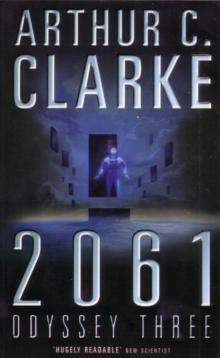 2061: Odyssey 3
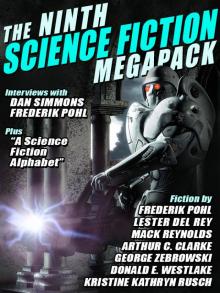 The Ninth Science Fiction Megapack
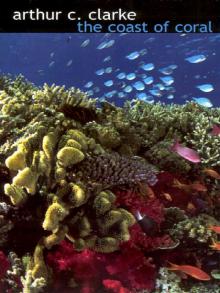 The Coast of Coral
 The Ghost from the Grand Banks (Arthur C. Clarke Collection)
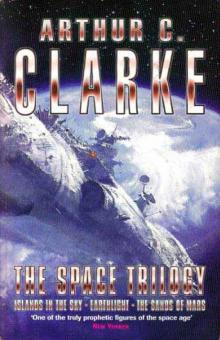 The Space Trilogy
 A Meeting With Medusa
 2001: A Space Odyssey (Arthur C. Clarke Collection: The Odyssey)
 Islands in the Sky (Arthur C. Clarke Collection)
 Rama II r-2
 Glide Path (Arthur C. Clarke Collection)
 The Sixth Science Fiction Megapack: 25 Classic and Modern Science Fiction Stories
 Tales from the White Hart (Arthur C. Clarke Collection: Short Stories)
 The Reluctant Orchid